Paradies

Our couch was enormous.
It wasn’t just a place to sit and watch T.V. It was upholstered geography, a vast yellow landscape plush enough to lose myself in.
When I was small, I’d worm myself under the cushions and tunnel my way into all sorts of make-believe. If I was sulking, I’d curl into a corner and pretend I was tucked into the crook of Ah Chan’s arm.
Ah Chan was my family’s ahma. In Hong Kong, where I was born and lived until I was nine, an ahma is more than just a maid. An ahma does everything for you. Smiley-faced and fifty-something, Ah Chan was my family’s everything.
She and I didn’t get to say a proper goodbye in the days between my father dying in a smashed-up Toyota and my being swept out of Hong Kong forever. At least, I don’t think we did. The sliver of time between his death and my vanishing into Texas is blank, a six-month wedge of empty.
My memory of Hong Kong before his accident isn’t much better, just a few fleeting images. Maybe more than a few. It’s hard to tell because they’re all torn to pieces. It’s as if the first nine years of my life exploded, leaving specks of confetti suspended midair, snippets of celluloid, shimmering, vivid but mute—all beyond reach:
Seawater crashing against the bow of the Star ferry to Kowloon, reeking of gasoline; Cantonese chatter clattering through the winding fish markets of Aberdeen; a lean man tugging on his swim trunks before sprinting into the sea.
Some scraps from the past come at me pressed together face-to-face. If I manage to pry the two moments apart, I have no idea which bit of history belongs where. If I’m lucky, fragments edit themselves together by chance and tell me a story that makes sense.
For the most part, they don’t.
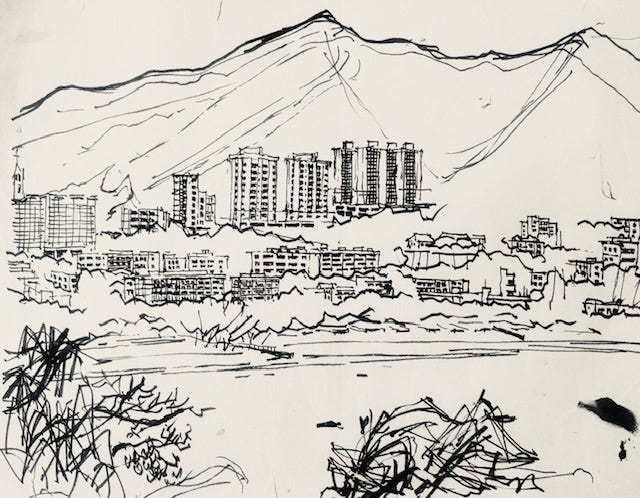
My family lived in Repulse Bay, an enclave on the quiet side of Hong Kong Island. In the 1960s, the coastal community was a respite for expats, executives, and the lazier waves of the South China Sea. It was a remote haven distinguished by a glassy blue building that dwarfed the smaller white flats dotting the coast.
We lived on the second floor of one of those sugar-cube blocks. Our home was a broad balcony with a kitchen, living room, and bedrooms attached. From the day I was born, my window onto the world was a rectangle of untroubled paradise, each day as easy as the one before it, right up until the day a man called Dad disappeared.
Everything I know about this enigmatic parent is rooted in second-hand anecdotes and the thousands of photographs I’ve dragged from place to place for fifty years: holiday snaps, Kodachrome slides, and sepia proof sheets marked up for print with a waxy red pencil.
My father worked in advertising, built an agency from the ground up. He had a bushy, orange beard and was built like a wrestler before he got fat. He was drunk when he skidded into a bus, in the dark, in the rain. They say he was impaled on a spike of twisted steel. True or not, once you hear a story like that, it’s hard not to picture your favorite parent dangling from the tip of a monstrous toothpick.
When he died, the drive that powered my family’s days petered out. Laughter evaporated. Hope drained away. It was as if I was living in a fairy tale where the jolly old king dies, and his kingdom clouds over forever, because a wizard on a hill said it must be so.
Mum becomes “Mum” in a collision of high-heeled shoes and overcooked eggs.
Here’s how I still see it:
My sisters, Abbey and Louise, and I are seated around the breakfast table before school. Abbey sits high in her chair, smearing the tray with jam-sticky hands. Louise, two years younger than I am, is her usual quiet self, staring at the sea beyond the window, fiddling with her stringy, yellow-white hair.
Ah Chan slips into the room silently with a buck-toothed smile and two plates of eggs. She wears a white tunic, black trousers, and grey fabric shoes. She sets the plates in front of Louise and me. Outside, a car crunches over gravel. Exotic birds squawk.
A stiletto steps in from the hall.
Mum, a raven-haired beauty—as in a magazine—splices awkwardly into our mellow morning. She circles the breakfast table, silently concerned about the milk and the tea. I’m struck by the emerald sheen radiating from her dress. An arm, the color of hazelnuts, glides over my shoulder to straighten a knife, then sweeps the tablecloth clean. A constellation of breadcrumbs tumbles to the floor.
Then it happens—that small, sharp thing. Mum’s pupils shrink fast, like an afternoon shadow moving quick over stone. She zeroes in on our boiled eggs, their tops lopped off, ready to eat.
“The yolks are hard,” she tells Ah Chan. “That’s what the toasted soldiers are for. They’re for dipping.”
Mum’s fingers scissor the air. Ah Chan lifts our plates and carries them away. Mum circles the table again, then stops to my right.
But I’m wrong.
Mum didn’t wear stilettos that morning or on any other day. I’ve insisted upon this image, a fragment of fiction bound up with traces of fact, collateral damage in the crush of time. My mother likely wore a plain cotton dress on that ordinary day. That, and a pair of rattan sandals. Mum was elegant, though, that much is true. Whenever she entered a room, I imagined a bronze comet blazing through my thin yellow light.
Equally icy. Just as remote.
Real or wrong, the day of the hard-boiled eggs has an end.
The evening air is balmy as I climb up to Ah Chan’s small rooftop home. Looking down at our block of flats from Repulse Bay Road after dark, her bedroom resembles a cherry plopped on top of a silhouette cake, thanks to the amber glow from a window that bleeds into the night.
A zig-zag staircase is bolted to the back of our building. I hoist myself up, two steps at a time.
Mum tells us to leave Ah Chan alone when she isn’t busy downstairs. I do as I’m told, but not always. I like it up where she lives. Ah Chan listens patiently as I blather on about school. Sometimes, I lean over the roof’s shallow wall while she pins Dad’s work shirts to a line, and I survey the bay below.
“Tsk, tsk,” Ah Chan says when I dangle too far. I scooch back an inch.
Each day plays out the same.
Boyfriends smear Coppertone onto their girlfriends’ shoulders like emperors lazily polishing gold. He spends the afternoon running in and out of the water while she flip-flops in the sun till the last of it is gone.
“The Americans are here!” I shout when I spot them, as if pirates are invading the bay. I’d point to a muddle of arms and legs thrashing around a raft a few hundred feet from the shore.
Chinese teenagers swarm the old Repulse Bay Hotel on the weekend. The girls are a jumble of bumblebee sunglasses, squeezed into hip-hugging jeans. They skim the veranda, linked at their fingertips, hair flapping like wet ink on a wall. One pulls a bottle from her denim bag; a flash of green sparkles at her lips as she swallows a mouthful of fizzy, cool 7-Up.
The evening breeze is chilly as I jump the final two steps to the roof.
Chinese music buzzes from Ah Chan’s transistor radio—whiny and jagged. I tiptoe to the back of her hut, skirt a corner, and peer inside. The room smells of fish bones and rice. A puff of steam strains at the lid of a bashed-up pot wobbling over something that isn’t a stove.
Ah Chan sits on the edge of her bed, cradling a bowl of soup. I want to slouch beside her, but I don’t. I lean into her threshold instead and scratch the back of my head. “I liked my eggs,” I blurt out.
Ah Chan looks up. Everything about her relaxes. Her knees. Her cheeks. Even her spoon.
“Too hard,” she says, placing her bowl on the floor.
She pats the mattress beside her, gets up, and walks to the simmering pot. I do as I’m told and lean back on my elbows, sinking into her bed. I scan a collage of pictures pinned around her room: an elaborate wedding; a serious young man; red envelopes; ivy-smothered shrines. I’ve studied them countless times before, always astonished that Ah Chan has a life somewhere else, without us.
She hands me some soup. I peer into the shrimpy broth. A salty vapor moistens my nose. Ah Chan sits beside me and takes a noisy slurp. I do the same. Beyond her bedroom door, the South China Sea rumbles. Lapping waves roil—then roar.
And with that, paradise collapses.
Bricks become rubble. Stone splinters into dust.
Halfway up a hillside, in a tangle of trees, I’m scratching at the soil. A blue canvas patch juts from a clump of wet, waxy leaves. Treasure, at last! I tug it loose. AMERICAN CLUB TOKYO JAPAN is stitched around its perimeter. In the center, an embroidered arm rises from a row of wiggly waves. The figure is meant to be swimming—or drowning. I still have that patch, in a box, on a shelf.
Insects hiss. My arms itch. The world smells of rot.
I’m a burglar, hiding on a windowsill, pressed against the glass. The window flies open. Tumbling. Grasping. Crunching into the ground. A nurse hands me a book. One Fish, Two Fish, Red Fish, Blue Fish. Fifty-seven staples dot my head. I reach for my ear and trace the weave of a scar back to the base of my skull.
Dark clouds scatter, the sea recedes—a bloated pig lies marooned, dead on the beach.
Mum is standing next to a sleek, navy-blue car. She’s handed a string of pearls by a slender man in a suit, about to leave for Dad’s funeral. On the grass nearby, a large dog clumsily mounts a smaller one. They stagger about on six legs. I’m confused. I’m appalled. I can’t look away.
When I do, Mum is gone.
Huffing and puffing in sensible shoes, I hoist myself up the zig-zag staircase to the roof one last time. Ah Chan is sitting on her cot, sobbing, her walls stripped of pictures. She looks at me, fingers fussing with something small in her lap. She hands me a packet.
“For you,” she says. “Sweets, for the plane.”